

Complete personal tax services in Canada cover federal filing, provincial requirements, and CRA compliance for residents, sole proprietors, and freelancers nationwide. Unity Financial Services prepares personal income tax returns, applies eligible deductions accurately, and explains province-specific rules before filing. Clients across Canadian provinces receive clear guidance on documents needed, filing deadlines, and next steps through a consultation with Unity Financial Services.
Key Takeaways
Unity Financial Services prepares personal tax returns for individuals across all Canadian provinces, with a head office in Quebec.
We handle corporate tax filing, bookkeeping, payroll support, and GST/HST/QST returns for self-employed people and small businesses.
Our firm offers catch-up bookkeeping and tax preparation with transparent fees and direct consultation available.
Contact Unity to discuss your tax needs
Who Needs to File a Personal Tax Return?
Filing obligations depend on various factors, including income sources and residency status, which can vary for each individual. Canadian residents, sole proprietors, and freelancers each face different triggers for personal tax filing. Missing one can mean penalties or lost benefits. Determining whether a return is required starts with a clear look at individual tax obligations for the year, including employment income, self-employment earnings, investment income, and government benefit repayments.
Families and individuals across every province share one thing in common: the need to confirm their status before assuming no return is necessary.
Do I need to file if I have no income?
Even with little or no income, filing often unlocks provincial credits, GST/HST rebates, and child benefit payments. Many households skip this step and lose money they were owed. A return also creates a record CRA uses for future benefit calculations.
What counts as being ready to file?
Being ready means having tax slips organized and a NETFILE access code on hand before the season opens. Updated personal information, such as address or marital status changes, also needs confirming ahead of time.
Unity Financial Services prepares personal tax returns for:
Employed and self-employed Canadians
Freelancers with multiple income streams
Small business owners across all provinces
Families managing combined household filings
Support extends nationwide, wherever clients call home.

How Do You File Personal Tax Online?
Three main paths exist for Canadian filers: certified tax software, paper filing by mail, or working with a tax specialist. Each route leads to the same destination, a completed return submitted to the Canada Revenue Agency. The amount of hands-on guidance differs a lot. Sole proprietors, freelancers, and families juggling multiple income slips often find that file personal tax online options save time compared to paper forms. Accuracy still depends on entering every slip correctly.
Choosing between these methods comes down to complexity and comfort level. A straightforward return with one T4 slip may suit software. Complex returns often benefit from assistance through a qualified preparer.
What happens after a return is filed?
Once submitted, filers can access their notice of assessment, confirm refund status, or request proof of income for a loan or benefit application. Filers can also pay a balance owing or ask the CRA to change a previously filed return. These after-filing steps matter as much as the filing itself, since errors caught early are easier to correct.
Unity Financial Services offers individual tax service support across Canadian provinces, explaining scope, fees, and next steps before any work begins. Residents wondering how how to file personal tax correctly. Unsure which method fits their situation, can request a consultation to review options suited to their income type and province.
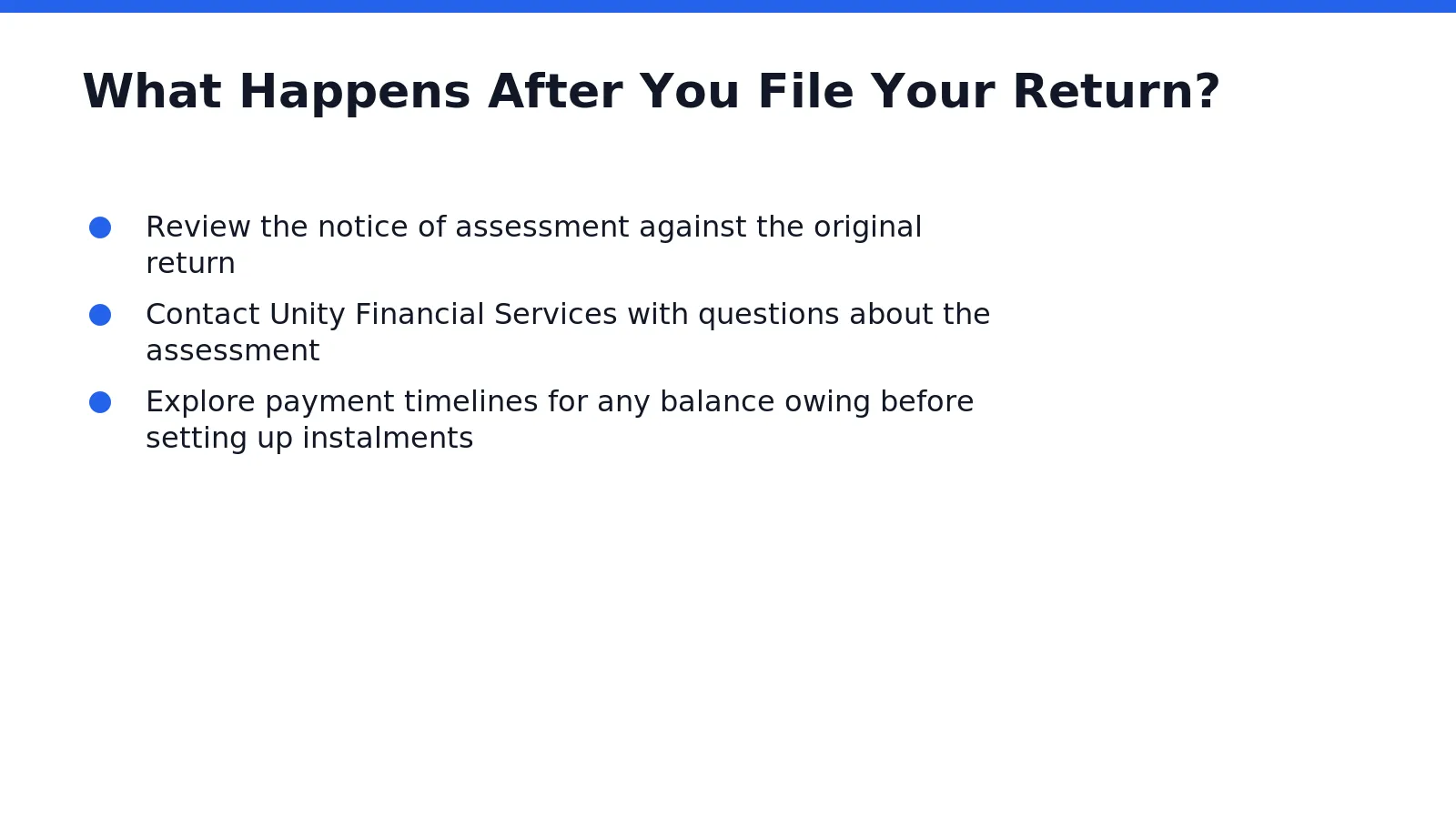
What Happens After You File Your Return?
A notice of assessment arrives first, confirming what the Canada Revenue Agency calculated based on the return submitted. Some residents receive a refund. Others discover a balance owing, and that news often triggers stress about how to cover it.
Balances owing don’t need to be paid in one lump sum. Options exist to pay a debt immediately or spread it out over time, and some individuals choose to pay next year’s taxes through instalments rather than face a large bill later. Reviewing the notice carefully matters, since errors in reported income or missed deductions can affect the final number.
Can someone in another province get help with a CRA balance?
Yes. Unity Financial Services keeps a physical office in Québec. That address marks a contact point, not a service boundary. Residents in any Canadian province can request tax return assistance for individuals to review an assessment or plan a payment approach.
Does Unity help with loans to cover a tax balance?
No. Unity Financial Services focuses on individual tax service work, including preparation and post-filing questions, and refers financial product inquiries to independent professionals who handle those applications separately.
Review the notice of assessment against the original return
Contact Unity Financial Services with questions about the assessment
Explore payment timelines for any balance owing before setting up instalments
Conclusion
In closing, managing your personal tax obligations across Canada doesn’t have to feel overwhelming. Unity Financial Services handles the core work, tax return preparation, bookkeeping, payroll support, and sales-tax filings, so you can focus on what matters most. Whether you’re self-employed, running a small business, or filing as an individual, reaching out for a consultation is the practical first step toward clarity and confidence in your tax situation.